The global wellness industry crossed the $5.6 trillion mark in 2022, according to the Global Wellness Institute — and massage therapy alone accounts for a significant share of that growth. Yet most spa owners and massage therapists still struggle to attract new clients online, not because their services lack quality, but because their digital presence is practically invisible. The problem is almost always the same : wrong keywords, weak content strategy, and no real understanding of what potential clients type into Google when their back is killing them on a Tuesday night.
We've spent considerable time analyzing search behavior in the wellness niche, and the patterns are clear. Targeting the right massage-related search terms can be the difference between a fully booked calendar and an empty treatment room. Let's break down exactly how to find, categorize, and use those keywords effectively.
Why keyword research matters for massage therapists and spa owners
Picture this : a first-time client moves to a new city, feels stressed after weeks of remote work, and opens Google to search for relief. They don't search for "therapeutic manual soft tissue manipulation." They type "deep tissue massage near me" or "best relaxing massage [city name]". If your website doesn't match those exact phrases — or close semantic variants — you simply don't exist for that person.
Keyword research bridges the gap between how you describe your services and how your clients actually search for them. This is especially critical in local service businesses like spas, where purchase intent is high and competition is intensely geographic. A massage studio in Austin, Texas, doesn't compete with one in Portland — but it absolutely competes with the five other studios within a three-mile radius.
According to BrightLocal's 2023 Local Consumer Review Survey, 98% of people used the internet to find information about local businesses in the past year. That statistic alone should make keyword strategy a top priority for any massage professional serious about growth. When we help businesses build their content infrastructure, mapping search intent to service pages is always step one — no exceptions.
The main categories of massage keywords you need to target
Not all wellness-related search terms carry the same weight. Some signal pure curiosity, others signal immediate buying intent. Understanding these categories helps you prioritize where to invest your SEO efforts first.
Service-type keywords : the backbone of your strategy
These are the most competitive — and the most valuable. Service-type keywords describe specific massage techniques that clients already know they want. Think :
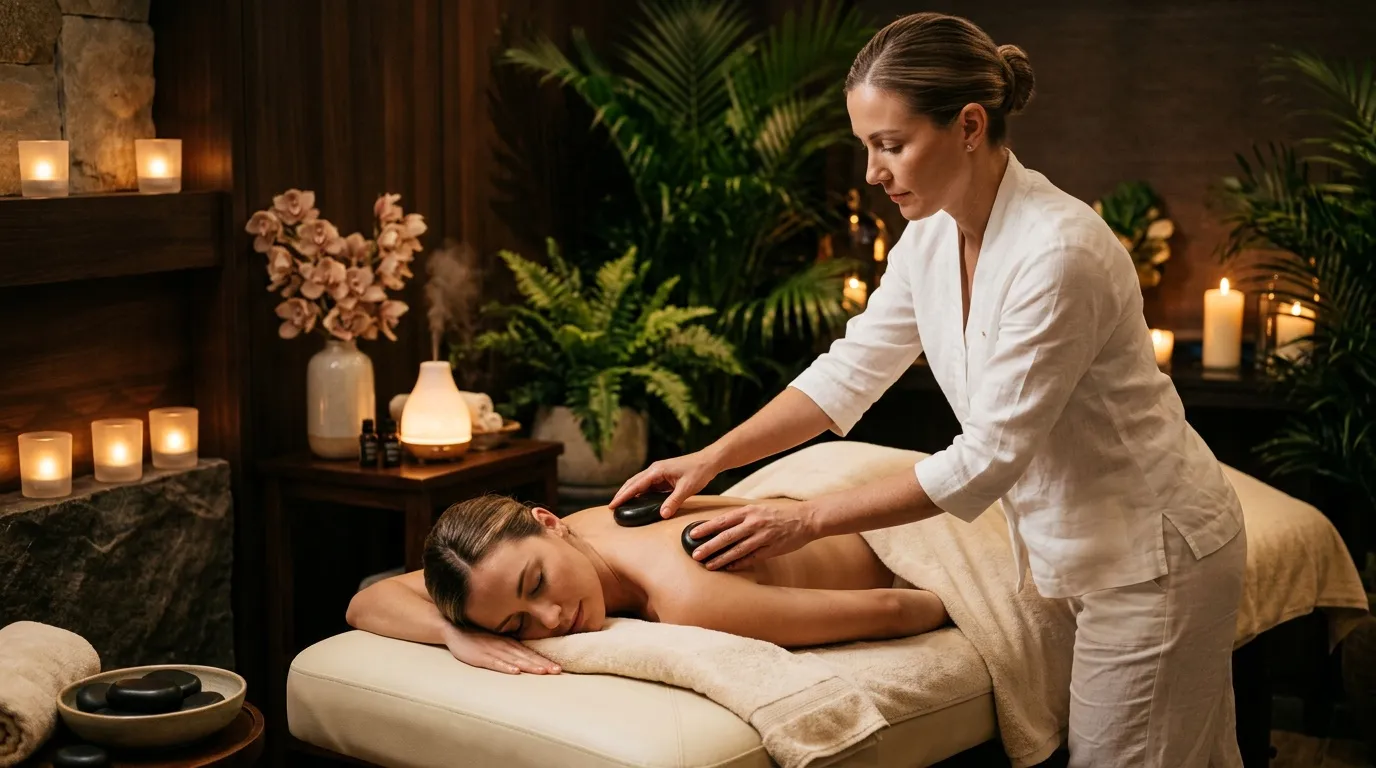
"Swedish massage," "deep tissue massage," "hot stone massage," "prenatal massage," "sports massage," "lymphatic drainage massage," or "Thai massage." Each of these deserves its own dedicated page on your website, not just a bullet point buried in a services list.
Why individual pages ? Because Google evaluates relevance at the page level. A single page trying to rank for twelve different massage types will almost never outrank a focused, well-structured page dedicated to just one technique. We always recommend creating one service page per modality, especially for high-volume terms like "deep tissue massage" which, according to Ahrefs data, generates tens of thousands of monthly searches in the US alone.
Don't overlook less common but highly specific modalities either. Niche service keywords like "myofascial release therapy," "craniosacral massage," or "Ashiatsu barefoot massage" attract a more informed audience — clients who have already researched their needs and are ready to book. Lower search volume, yes, but significantly higher conversion rates.
Benefit-focused keywords : targeting the pain, not just the service
Here's something many spa owners miss entirely. A large segment of potential clients doesn't search by technique — they search by problem. They type things like "massage for lower back pain," "massage to reduce anxiety," "massage for insomnia," or "massage after marathon."
Benefit-driven search terms tap directly into the emotional and physical motivations of your ideal client. These keywords are often less competitive than generic service terms, making them an excellent opportunity for newer or smaller businesses to rank on page one without an enormous content budget.
Consider building dedicated blog content around these queries. A well-written article titled "How deep tissue massage helps relieve chronic lower back pain" can rank for dozens of related long-tail terms simultaneously. This is exactly the type of content strategy that AI-powered content generation platforms like Skoatch are built to scale efficiently — producing topically authoritative pieces that serve both search engines and real readers.
Some benefit-focused keywords worth integrating into your content plan : "stress relief massage," "massage for headache relief," "massage to improve circulation," "massage for sciatica pain," "relaxation massage benefits." Map each one to a specific service or article, and you'll start building genuine topical authority in the wellness space.
Location-based keywords : capturing the local search market
For most massage businesses, local SEO is where the real money is. When someone searches "massage therapy [city]" or "spa near me," they're typically ready to book within hours — sometimes minutes. These are the highest-converting searches in the entire category.
The classic formula combines service + location : "Swedish massage Chicago," "prenatal massage Brooklyn," "sports massage Austin TX," "couples massage downtown Denver." But don't stop there. Neighborhood-level targeting often outperforms city-level targeting in dense urban markets. Ranking for "massage therapist Williamsburg Brooklyn" might be far easier — and more profitable — than competing for the entire borough.
Interestingly, the same logic applies to other local service businesses. If you've ever explored SEO keyword strategies for service-based local businesses like florists, you'll notice the patterns are remarkably similar : hyper-local targeting, service-specific pages, and intent-matched content consistently outperform generic approaches.
Don't ignore "near me" variants. Although you can't literally put "near me" in your content naturally, optimizing your Google Business Profile with accurate location data, service categories, and regular updates feeds directly into these proximity-based searches. It's one of the highest-leverage actions a local spa can take.
Long-tail massage keywords : where hidden traffic lives
Short, broad keywords like "massage" or "spa" attract enormous search volume — and brutal competition. A small wellness studio going head-to-head with franchise chains and major booking platforms on those terms is, frankly, a losing battle.
Long-tail keywords are the smarter play. These are phrases of three, four, or five words that are more specific and, as a result, less contested. They might individually bring fewer monthly visitors, but collectively they can drive the majority of your organic traffic — and those visitors convert at a much higher rate because their intent is crystal clear.
Here are concrete examples of high-value long-tail massage search terms :
"How often should you get a deep tissue massage," "best massage for stress and anxiety relief," "is hot stone massage safe during pregnancy," "what to expect from your first Thai massage," "how long does a lymphatic drainage massage take."
These question-based queries are gold for blog content. They align perfectly with Google's People Also Ask boxes and featured snippets — two SERP features that can dramatically increase your visibility even if you don't hold the top organic position. We consistently find that businesses investing in question-based content around their core services see measurable traffic gains within 90 to 120 days of publication.
Competitive and transactional keywords : capturing booking intent
Not every search is informational. Some visitors arrive already knowing what they want — they just need to find the right provider. Transactional keywords signal this high-intent behavior, and they deserve prime placement on your service pages, booking buttons, and meta descriptions.
Classic transactional massage phrases include : "book a massage online," "massage appointment same day," "massage gift certificate," "massage deals near me," "affordable deep tissue massage," and "best-rated massage therapist [city]."
The word "best" appears frequently in transactional spa searches. This is worth noting because it changes how you should frame your content. When someone searches for the "best massage for sore muscles," they want a clear recommendation — not a neutral rundown of every technique in existence. Take a position. Recommend specifically. That directness actually helps with engagement metrics, which in turn supports rankings.
Price-related keywords also deserve attention. "How much does a 60-minute Swedish massage cost," "massage prices [city]," and "cheap massage near me" attract price-sensitive searchers who are still in decision mode. A transparent pricing page — optimized for these terms — can convert fence-sitters into paying clients. Don't hide your prices out of fear of comparison; transparency builds trust and reduces friction in the booking process.
Seasonal and event-driven massage keywords
Search behavior in the massage industry isn't flat year-round. Certain terms spike at predictable times, and capitalizing on those patterns gives you a significant edge over competitors who publish static content and never revisit it.
Holiday and gifting seasons drive massive search volume for specific terms. Between October and December, queries like "massage gift cards for Christmas," "holiday spa packages," "couples massage Valentine's Day," and "spa day gift ideas" see dramatic increases. Publishing or refreshing content around these phrases six to eight weeks before peak season is standard best practice — Google needs time to index and assess new pages.
Sports-adjacent timing matters too. Around major marathon seasons — Boston Marathon runs every April, for instance — searches for "pre-race sports massage," "post-marathon recovery massage," and "athlete massage therapy" spike significantly in those cities. If your studio sits near a race route or training hub, building content around these seasonal windows can bring highly targeted traffic that your competitors haven't thought to capture.
Mother's Day deserves special mention. It's one of the single biggest booking weekends of the year for spas globally. "Mother's Day massage deals," "spa gift for mom," and "Mother's Day relaxation package" are high-converting phrases that typically start trending in late April. Start building and promoting that content now rather than two days before the holiday.
How to structure your website content around massage keywords
Identifying the right search terms is only half the work. How you deploy them across your website architecture determines whether Google can understand and rank your content appropriately.
Page hierarchy and keyword mapping
Your homepage should target your broadest, most competitive term — typically "massage therapy [city]" or "day spa [city]." Below that, individual service pages each target a specific modality keyword. Your blog handles informational and long-tail queries. This three-tier structure is clean, logical, and exactly what search engines reward.
Avoid what SEOs call "keyword cannibalization" — multiple pages competing for the same phrase. If your homepage and your Swedish massage page both try to rank for "Swedish massage [city]," they'll split authority and neither will perform well. Each page should own a distinct keyword cluster, with clear internal links connecting related content.
Meta titles and H1 tags should contain the primary keyword for each page. But don't stuff. A title like "Deep tissue massage in Seattle | Professional massage therapy" is clean, readable, and keyword-rich without feeling robotic. When we audit site structures for wellness businesses, poor title tag optimization is consistently among the top three fixable issues we find — and fixing it alone often produces ranking improvements within weeks.
Using keywords naturally in your body content
There's a persistent myth that good SEO requires awkward, repetitive keyword insertion. It doesn't — not anymore. Modern Google algorithms, particularly since the Helpful Content Update rolled out in late 2022, actively penalize thin or keyword-stuffed content in favor of genuinely useful, naturally written pages.
The practical implication : write for your client first, then check that your target keyword and its variants appear naturally throughout. A 600-word service page for "hot stone massage" should naturally mention the technique's benefits, what the session feels like, how long it lasts, and who it's best suited for. If you write authentically about the service, the relevant terminology will appear organically — because it's simply the vocabulary of the subject.
Semantic relevance matters enormously here. Terms like "heat therapy," "muscle tension," "volcanic basalt stones," "circulation improvement," and "stress hormones" all reinforce your page's topical authority on hot stone massage without repeating the exact phrase over and over. Rich, varied vocabulary signals expertise to both readers and algorithms.
Tools and methods to find the best massage search terms
Strategy without data is just guesswork. Fortunately, several reliable tools exist to inform your keyword decisions with real search volume and competition data.
Google Keyword Planner remains a solid starting point, especially for local volume estimates. Type in seed terms like "massage therapy," "spa services," or "relaxation massage" and let the tool surface related queries you might not have considered. Filter by location to see what your specific market actually searches for.
Ahrefs and Semrush both offer more granular competitive data, including keyword difficulty scores that help you prioritize realistically. A new wellness business with low domain authority should focus on keywords with difficulty scores below 20 — these are genuinely winnable positions without requiring years of link-building first.
Don't overlook Google's own search features as a free research tool. The autocomplete suggestions when you start typing a massage-related query reveal real user behavior. The "People Also Ask" section shows exactly what follow-up questions your content should address. The related searches at the bottom of a results page offer additional keyword variations worth incorporating. These three features alone can fuel a solid three-month content calendar for any spa business.
One workflow we find highly effective : use automated content tools to generate initial keyword-rich drafts for service pages, then apply human expertise to refine tone, add specific local details, and ensure clinical accuracy where relevant. This hybrid approach dramatically accelerates production without sacrificing quality — which is precisely why platforms purpose-built for SEO content generation have become standard in the digital marketing toolkit for service businesses.
Common keyword mistakes that hurt massage businesses online
Knowing what to do matters. Knowing what to avoid matters just as much. Several recurring errors consistently undermine the SEO performance of wellness businesses, even those with otherwise excellent services.
Targeting only generic terms is the most common trap. Ranking for "massage" as a standalone keyword is practically impossible for an independent studio — the SERPs for that term are dominated by booking aggregators like Booksy, Vagaro, and Mindbody. Focus your energy on specific, local, and long-tail variations where you can realistically compete.
Ignoring mobile optimization is another critical error. Over 60% of local service searches happen on smartphones, and Google uses mobile-first indexing. If your booking page loads slowly or your keyword-rich content is buried behind poor mobile UX, even perfect keyword targeting won't save your rankings. Page speed and mobile responsiveness are non-negotiable technical SEO requirements today.
Finally, many spa businesses create excellent keyword-targeted content once — then never update it. Search trends shift. New modalities gain popularity. Local competitors publish fresh content. "Lymphatic drainage massage" saw explosive search growth between 2021 and 2023, largely driven by social media coverage of celebrity wellness routines. Businesses that had existing content on that topic benefited enormously; those that hadn't covered it missed the wave entirely. Quarterly content audits aren't optional if you want to maintain and grow organic visibility.
Building a long-term massage keyword strategy that compounds over time
The most sustainable SEO gains in the wellness space don't come from chasing individual keywords — they come from building genuine topical authority across an interconnected web of related content. Think of it as a content ecosystem rather than a list of target phrases.
Start with your core service pages, properly optimized for specific modalities and local intent. Layer in benefit-focused blog articles that answer real client questions. Add seasonal content timed to predictable traffic spikes. Connect everything with deliberate internal linking so that authority flows between pages. Refresh your highest-performing content every six months to keep it current and competitive.
This architecture compounds. A site with 40 well-structured, interlinked pieces of massage-related content outperforms a site with 200 thin, disconnected pages every single time. Depth and coherence beat volume — always. The businesses we see breaking through in competitive local wellness markets are almost always those treating content as a long-term asset rather than a short-term traffic tactic.
Consider expanding your keyword strategy beyond purely massage-focused terms. "Wellness routine," "self-care tips," "stress management techniques," and "holistic health practices" are adjacent topics that attract your ideal audience at earlier stages of awareness. Capturing readers at the consideration stage — before they've even decided they want a massage — builds brand familiarity that pays off when they finally do reach the booking stage. Top-of-funnel content is an underused asset in the spa and wellness industry, and it represents one of the clearest opportunities to differentiate your online presence from competitors who only publish service-page content.