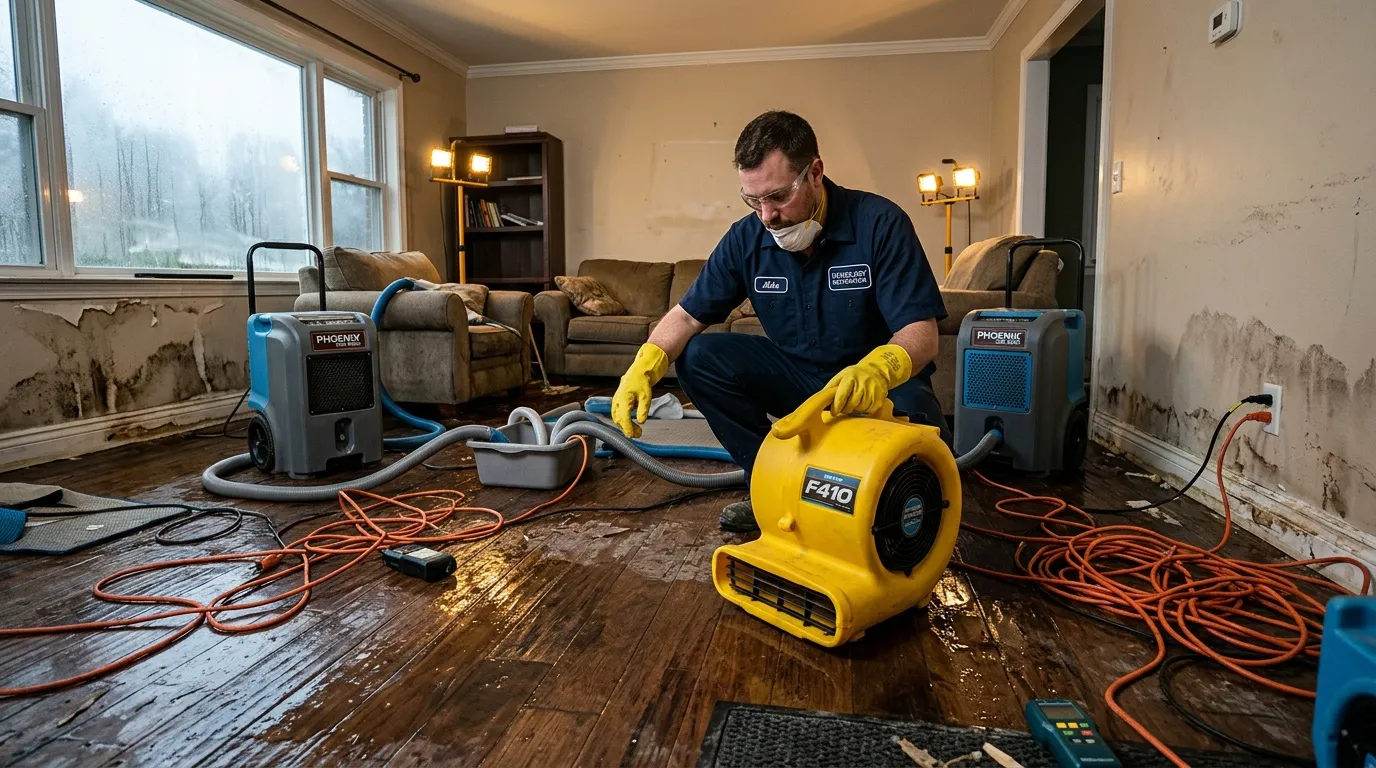
When a pipe bursts at 2 a.m., homeowners don't search for "water restoration tips" — they type "emergency water damage company near me." Choosing the right SEO keywords for your water damage restoration business is the difference between answering that call and watching a competitor do it. Ranking for vague, low-intent terms wastes your budget and drains your team's energy. This article covers the most valuable keyword categories, how to structure them across your website, and how to track their real impact on conversions and revenue.
Targeting high-intent keywords that drive emergency calls
Not all searches carry the same urgency. A homeowner typing "what causes mold" is browsing. One typing "mold remediation service near me" is ready to hire within the hour. That gap is everything in this industry.
High-intent keywords signal immediate need. They combine four proven formula patterns that consistently attract qualified leads. First, service type plus location — think "basement flood cleanup in Chicago." Second, emergency modifier plus service — "24/7 water extraction" or "emergency water damage restoration." Third, problem plus location — "sewage backup help near me." Fourth, the classic near me modifier appended to any core service term.
Long-tail variations outperform generic terms in conversions despite lower search volume. Someone typing "flooded crawl space cleanup contractor near me" has a precise, urgent need. That specificity makes them far more likely to call your team immediately.
Build a core list of 15 to 20 primary keywords, each tied to a dedicated service or location page. Support those with 30 to 50 long-tail search terms to balance reach with conversion potential. Urgency language — emergency, 24/7, immediate, fast — functions as a conversion multiplier. These words don't just describe availability; they attract the homeowners who need your crew dispatched right now.
The complete keyword list by water damage service category
A restoration company that covers every service category leaves no gap in its search visibility. Each category below should map to a dedicated page on your website, ensuring Google understands your full scope of expertise.
Water damage restoration and cleanup terms form your foundation : "water damage restoration companies near me," "water damage cleanup service," "water damage repair near me," and "water remediation company." These drive the highest volume.
For water extraction and removal, target "water extraction services," "emergency water removal services," and "water mitigation company near me." Flood-specific searches — "flood cleanup near me," "flood damage repair," "flooded basement cleanup companies near me" — require their own dedicated pages.
Mold removal and mold remediation terms attract homeowners dealing with post-water damage consequences. "Mold remediation services," "mold removal specialist near me," and "water and mold damage restoration" are strong performers. Fire and smoke damage terms — "fire damage restoration service," "smoke odor removal," "fire and water restoration" — complete a well-rounded keyword strategy.
Don't overlook burst and frozen pipe searches : "burst pipe damage," "frozen pipe burst," and "busted water pipe" capture high-urgency leads. Below are standout terms with verified monthly data :
| Keyword | Monthly searches | CPC |
|---|---|---|
| Water damage restoration companies near me | 368,000 | $72.58 |
| Emergency water damage restoration | 1,900 | $101.00 |
| Residential water damage restoration near me | 480 | $92.41 |
| Professional water damage restoration companies | 210 | $119.89 |
These figures confirm that emergency-intent keywords command premium CPCs — and reward organic rankings with high-quality leads that convert.

How to structure your website around your target keywords
Your homepage targets broad terms like "restoration company" or "disaster restoration services." Every other page serves a more specific purpose. Each target keyword maps to exactly one page — this prevents cannibalization and keeps your authority concentrated.
Your site architecture should include :
- Individual service pages for water damage restoration, water extraction, fire damage cleanup, mold remediation, smoke damage, and biohazard cleaning
- Separate residential and commercial service pages
- Dedicated location pages for every city and service area you cover
- A blog section organized around pillar clusters linking back to core service pages
A page titled "Basement flood cleanup in Springfield" outperforms a generic "Water damage restoration" page for local searches every time. Include local landmarks, neighborhood mentions, and embedded Google Maps to reinforce geographic relevance.
Use clean, hyphenated, keyword-inclusive URLs — for example, /services/water-damage-restoration or /locations/flood-restoration-florida/. Avoid ID-based URLs with special characters.
Every service and location page needs hyper-local H1 headings combining city and service, a visible phone number, a contact form above the fold, local customer reviews, image alt text using local and service keywords, and schema markup covering LocalBusiness, Service, FAQ, and Review types. Internal linking between related service pages, location pages, and blog posts strengthens the entire structure. Tools like AI-powered content generation platforms help teams produce optimized pages at scale without sacrificing quality or consistency.

Local SEO and Google Business Profile optimization for restoration keywords
Local SEO is the highest priority for any water damage company. Customers need immediate help nearby — local search rankings directly determine your emergency response volume.
Your Google Business Profile primary category must be "Water Damage Restoration Service." Add secondary categories such as "Sewage cleanup service" and "Fire damage restoration service." List specific cities, towns, and zip codes in your service area. Upload geo-tagged photos of your crew, branded equipment, and active job sites. Use the Q&A section to answer urgent questions — "Are you available 24/7 ?", "Do you work with insurance claims ?" — before customers even need to ask.
Publish regular posts featuring emergency availability announcements, before-and-after job photos, and local project completions. Consistency here builds trust and signals active management to Google.
NAP consistency across all directories — name, address, phone — is a direct ranking signal. An inconsistency as small as "Main St" versus "Main Street" is flagged by Google and can harm your local rankings. Build citations across platforms like Yelp, Angi, the Better Business Bureau, HomeAdvisor, Thumbtack, and your local chamber of commerce.
Reviews are a major local ranking factor. Research confirms that 75% of consumers research a business online before contacting them. After each job, your lead technician confirms satisfaction, then sends a personalized text with a direct Google review link referencing the specific project. Respond to every review — thank customers by name for positive feedback, and address frustration professionally for negative ones.
| Google Business Profile element | SEO impact |
|---|---|
| Primary category (Water Damage Restoration Service) | Critical — determines primary local search visibility |
| NAP consistency | High — inconsistency is a negative ranking signal |
| Geo-tagged photos | Medium — supports local relevance signals |
| Review volume and recency | High — directly influences trust and rankings |
Just as a well-researched keyword list for jewellery businesses maps intent to category pages, your restoration keyword strategy must align each search term with a precise local page built to convert.

Measuring keyword performance and tracking SEO results
Traffic without conversions is noise. Tracking the right metrics separates a strategy that generates leads from one that merely generates impressions.
Monitor these key performance indicators consistently :
- Keyword rankings for high-intent local terms like "water damage restoration [city]" and "mold remediation [city]"
- Organic traffic volume and source breakdown
- Click-through rates from search results pages
- Conversions : calls, form submissions, and quote requests
Your recommended tool stack combines free and premium options. Google Analytics 4 tracks traffic, user behavior, and conversion events. Google Search Console monitors search performance, indexing status, and organic clicks. For keyword rankings and competitor analysis, Ahrefs and SEMrush deliver detailed competitive intelligence. Microsoft Clarity provides free heatmap and session recording data. Google PageSpeed Insights flags technical performance issues that slow your pages and hurt rankings.
Realistic SEO timelines matter here. Meaningful organic results typically appear within 3 to 6 months. Highly competitive markets can require up to 12 months of sustained effort. Google Business Profile optimizations often show early wins within just a few weeks. PPC delivers immediate visibility but stops generating leads the moment your budget runs out. SEO, by contrast, builds compounding organic authority — the longer you invest, the stronger and more self-sustaining your lead flow becomes.
The restoration market was projected to reach $7.1 billion by 2025, with over 35,000 registered businesses competing for local visibility. In that environment, disciplined keyword targeting combined with rigorous performance tracking is not optional — it's the engine that drives sustainable growth. Skoatch helps content teams apply exactly this kind of data-driven methodology at speed and scale.